Every measure on this page rests on powers a city already holds. Nothing here waits for a new national law, for automation, or for a budget that does not exist yet.
first: apply the law you already have
Before any measure on this page, there is one that requires no decision, no new power and no budget line: doing what the existing law already requires. It is listed first because it is the largest single improvement available to most cities and the one least often attempted.
the law has already set the priority
The hierarchy is not in dispute and does not have to be argued for. Constitutions and general law put the protection of human life and physical integrity at the top, and increasingly place the natural foundations of life alongside it, with an express duty of the state to protect both. Below that sit a dense set of binding and entirely specific requirements.
None of this is new, contested or awaiting a majority. It is in force, it is specific enough to act on, and in almost every case it already ranks life above convenience and above traffic flow.
the gap is not in the law
What happens in practice inverts the ranking. Junctions are parked up to the corner, pavements are reduced below the width a wheelchair needs, hydrants are blocked, and access routes that a fire appliance is legally required to be able to use cannot be used by one. Air quality and noise plans are adopted and then not delivered, sometimes for a decade, without anything following from it.
Two failures run in parallel. Administrations do not consistently comply with the law that binds them. And supervisory authorities, enforcement offices and the police carry out their monitoring duties only partially – and in most places nothing follows for anyone responsible, in either case.
A city that simply did what it is already obliged to do would be a considerably better city, before a single new instrument is introduced.
There is also a credibility consequence. An authority asking residents to accept a charge, a reallocation of space or a change to their parking, while cars stand in the fire service access route outside its own town hall, has a legitimacy problem that no communication strategy repairs. Enforcement of the existing rules is the precondition for being believed about the new ones.
the staffing argument, taken seriously
The standard answer is that there are not enough staff. That is not purely an excuse – enforcement capacity is genuinely thin in most authorities. It is, however, almost always asserted rather than worked out, and there are three responses to it.
derive it instead of asserting it
How many hours a week are spent on enforcement, on what, in which streets, with what measured effect? Against that, the condition the law requires. The difference is a gap with a size, a cost and a named way to close it. A council may then decide to carry that gap – openly, on the record, with the consequences stated. What is not available is to leave it undescribed and call it a shortage.
make the existing duties cheaper to discharge
This is what stewardship governance is for. One opening of a street surface, with everything due carried out at the same time, instead of three separate openings by three bodies that did not ask each other. Clear responsibility so that work is not done twice or not at all. Decisions documented once, in a form that survives the people who took them. None of that is additional work; it is the same work, organised.
design the need for enforcement away
A bollard needs no patrol. A junction built out so that a vehicle physically cannot stand in the sight line needs no ticket, this year or in twenty years. In the ranking of measures, enforcement is an organisational measure – the third level. A physical change that makes the violation impossible sits at the first or second, costs once, and then holds without any staff at all. Every recurring enforcement problem should therefore be examined first as a design problem, and only what cannot be designed out should consume patrol hours. The third is the one that actually resolves the staffing argument, and it is the one least often tried – because a bollard is a capital item that someone has to approve, and a shortage of enforcement staff is a condition that nobody has to approve.
digitise what has to stay
Where enforcement cannot be designed out, it can largely be automated, and several European countries demonstrate how effective that is. Automated camera enforcement with direct sanctioning, digital parking enforcement, and scan vehicles that detect illegal parking as they drive past are all in routine use. Automated speed enforcement is also the better instrument where lower speeds are the aim, because unlike a speed hump it does not delay an ambulance or shake a patient in one.
Four conditions keep this defensible, and they should be settled before the first camera.
- a clear legal basis and a data protection design that retains only what is needed for the specific offence
- a straightforward route of objection for the person sanctioned
- targeting by harm rather than by ease – the junction, the hydrant, the access route and the pavement first, not whatever is simplest to detect
- no dependence of the authority’s budget on the revenue, which is what turns enforcement into a levy and loses the public
Enforcement that is predictable, announced, aimed at what actually causes harm and accompanied by physical measures wherever those are possible is both more effective and easier to defend.
and consequences where nothing is done
Where a requirement is documented, the failure to meet it is documented, and nothing follows after a formal warning, that is not an oversight. If avoidable delay or harm results, whether the responsible bodies acted negligently belongs on the record and not in a press statement. Safety in the public realm is not an option exercised when resources allow. It is a duty of public planning and of public supervision, and the act treats persistent failure to act on a documented gap accordingly.
order of priorities
the street as a space for people
Where street space is scarce, conflicts between uses arise. Implementing a explicit order is the single most useful decision a council can take, because every later question answers itself from it. While one condition shall never be traded: the emergency incident access. That is a legal obligation, not a preference.
Within it, street space shall be allocated in this order:
- emergency incident access
- walking and cycling, including safe crossings and places to stop and rest
- public transport and public on-demand services
- services of general interest: care, social services, the supply of public facilities
- climate adaptation: trees, shade, unsealed ground, space for rainwater
- deliveries, trades and commercial services, in bookable time windows
- private motorised traffic, including commercial and automated fleets
- parking of private vehicles
This is not a new idea. Brussels plans by the STOP principle, and the UK Highway Code has s
hierachy of controls
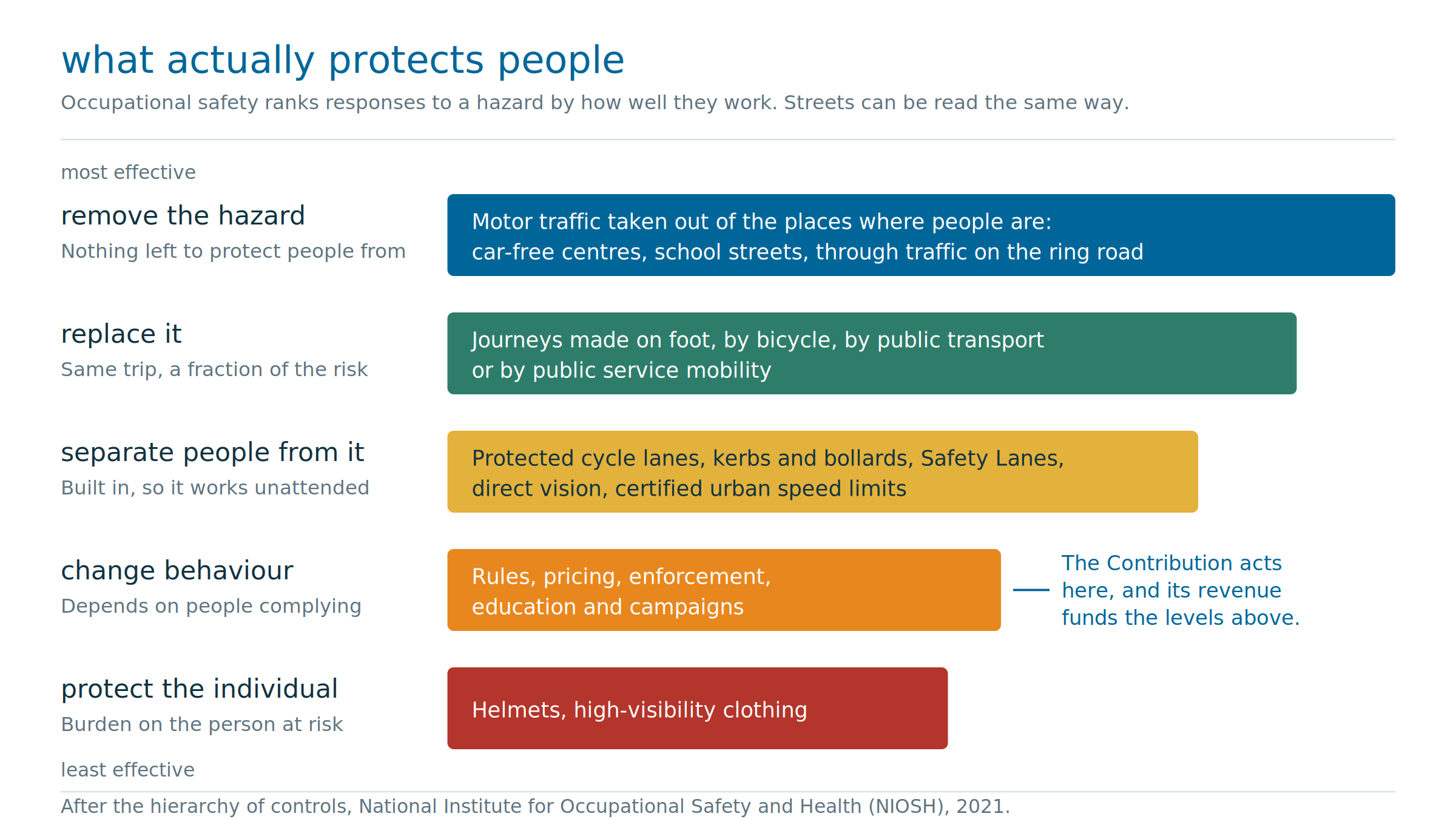
Occupational safety has ranked responses to hazards for decades. Removing a hazard works best; protecting the individual exposed to it works least. Measures that depend on people behaving correctly, every day and under pressure, fail more often than measures built into the place itself.
Applied to mobility, that explains both what to do first and what we do not recommend. Asking people to be careful, and equipment worn by those at risk, are the levels that have been relied on longest and have delivered least.
best practices
citizens writing the law
Berlin, mobility: in 2016 the citizens’ initiative Volksentscheid Fahrrad collected more than 100 000 signatures in about three weeks. Its draft became the basis of Germany’s first Mobility Act, passed in June 2018. The Act turns the principle of the car-friendly city around, and the initiative became the model for many cycling referendums in other German cities.
Berlin, climate adaptation: in November 2025 the Berlin parliament adopted a Climate Adaptation Act based on a draft by the citizens’ initiative BaumEntscheid, with no votes against. It was the first time the parliament adopted a law drafted by the city’s residents essentially unchanged, after an application for a referendum. By 2040 Berlin is to have more than a million trees, more than twice as many as today. The Act also covers heat action plans and rainwater management.
Berlin, and what it takes to deliver: Berlin also shows the other side. Implementation of the Mobility Act lagged from the start, held back by unclear responsibilities between the city and its districts. After a change of government in 2023, nearly 20 planned cycle lane projects were halted for review, and an amendment to the Mobility Act weakened several of its cycling targets. A law sets the direction. Without the political will to deliver it, it stays on paper. This is why stewardship governance counts a gap as closed only once a programme to resolve it is actually underway.
pricing the use of street space
- London: congestion pricing in central London sincFebruary 2003, later extended by the Ultra Low Emission Zone, which has covered all of Greater London since 2023. (dot)
- Stockholm: a trial in 2006, then a referendum, then permanent charges from 2007. Approval rose from under 30 % before the trial to over 55 % towards its end, and reached roughly 70 % by 2011. The clearest European evidence that acceptance can grow after introduction. (The Stockholm congestion charges – five years on. Effects, +2)
- Gothenburg: a congestion tax since 2013, on the Stockholm model.
- Milan: Area C, a charge for entering the historic centre since 2012.
- Oslo: a toll ring around the city since 1990, its revenue spent on transport.
- Paris: a parking tariff by vehicle weight. It applies to combustion and hybrid cars from 1,6 t and electric cars from 2 t, and raised the hourly rate from 6 to 18 € in the centre. Residents, trades and care services are exempt.
- Lyon, Grenoble, Koblenz, Tübingen: parking charges graded by vehicle size or mass.
- Vienna: parking management across the whole city, and an annual public transport ticket for 365 €, which shows what a cheap, simple alternative can do.
taking through traffic out of neighbourhoods
- Groningen: the centre divided into sectors since the 1970s, with no driving between them.
- Ghent: the same principle through its circulation plan of 2017.
- Leuven: a circulation plan on the same model since 2016.
- Brussels: low-traffic neighbourhoods under the Good Move plan, and a large pedestrian zone in the historic centre.
- Barcelona: superblocks that take through traffic out of whole neighbourhoods, followed by green axes across the Eixample.
- Vitoria-Gasteiz: superblocks as the basis of its mobility plan.
London: more than 100 low-traffic neighbourhoods delivered with the boroughs. (london) - Pontevedra: a car-free historic centre since 1999.
speed and Vision Zero
- Graz: 30 km/h on all but the main roads since 1992.
- Bilbao: 30 km/h on almost every city street since 2020.
- Brussels: 30 km/h across the region since 2021.
- Paris: 30 km/h on almost all streets since 2021.
- Helsinki: more than half of its streets now at 30 km/h, with safer junctions, raised crossings and separated traffic. No traffic death in the city for more than a year, the last one in July 2024.
- Oslo: less car traffic, lower speed limits, better infrastructure and protected zones around schools. Together with Helsinki, not a single pedestrian or cyclist killed in 2019.
- Bologna: 30 km/h on most streets since January 2024. In the first year, for the first time since 1991, no pedestrian was killed, and serious crashes fell by 31 %. (hdmotori) (autoblog)
Amsterdam: 30 km/h on most streets since the end of 2023.
Wales: 20 mph as the default limit in built-up areas, across a whole country, since 2023.
children and the way to school
- Paris: by September 2025, more than 300 streets at half of all nursery and primary schools had been calmed, 100 of them redesigned and planted.
- London: more than 640 School Streets. They reduce nitrogen dioxide at the morning drop-off by up to 23 %.
- Oslo: protected heart zones around schools.
- Vienna: school streets closed to motor traffic at the start of the school day.
- Barcelona: school surroundings redesigned as protected places to stay.
giving space back to people
- Paris: the Seine riverbanks and the rue de Rivoli returned to walking and cycling, and large-scale tree planting.
- Oslo: parking spaces in the centre replaced by seating, greenery, play and cycle lanes.
- Utrecht: an urban motorway turned back into a canal.
- Ljubljana: a city centre given over to walking, with small electric shuttles for those who need them.
- Pontevedra: a whole city built around walking.
cycling networks
- Copenhagen: cycle superhighways into the suburbs, dedicated cycle bridges and signals timed for cyclists.
- Utrecht: one of the densest cycling networks in Europe, and the largest bicycle parking garage in the world at the main station.
- Groningen: the city where most trips are made by bicycle.
- Seville: a connected network of protected cycle tracks built within a few years, showing that a city in the south can become a cycling city quickly.
vehicles and their rules
- London: the Direct Vision Standard, which makes access for heavy goods vehicles depend on what the driver can see directly.
- Paris, Madrid, Prague: shared e-scooters removed from the streets. In Paris this followed a residents’ vote.
- Brussels: shared e-scooters banned from 1 January 2027, while shared bicycles remain, on a new station-based system.
public on-demand services as part of public transport
Oslo, Herford, Geneva: the three cities of the European ULTIMO project, where automated vehicles are being deployed as part of public transport, not alongside it. In Oslo’s Groruddalen district, electric automated shuttles have been running since February 2025.
new districts without car dependence
- Freiburg: the Vauban district, largely car-free since the early 2000s.
- Utrecht: Merwede, a car-free district for around 12 000 residents, under construction.
- Vienna: Seestadt Aspern, a new district planned around public transport and short distances.
Have we missed a city? Almost certainly. Tell us, and it will be added.
What these best practices have in common is instructive. In each case the quality people experience – quiet, safety, children moving on their own, commercial life on the pavement – came from deliberate design and civil engineering, not from the absence of intervention. Pontevedra, Ghent, Groningen and Utrecht are among the most heavily engineered street environments in Europe. That is the encouraging part: what was made deliberately can be reproduced. They share two further features. Each was politically contested before it was popular. And each was paid for from the general municipal budget rather than from the traffic it displaced – which is why each one had to win a separate budget fight.
beautiful cities community
Europe does not lack city networks working on urban mobility — CIVITAS, Eurocities, POLIS, ICLEI, the Clean Cities Campaign, URBACT, NetZeroCities and EIT Urban Mobility among them. Each does valuable work, and for a small administration the number of them is itself a burden: the same questions are discussed in several places and the results are spread across platforms nobody has time to follow.
What is proposed is not another network but one shared community on street space, safety and its fair pricing, formed by the networks that already exist. Internally, a working exchange where officials share draft by-laws, procurement clauses, calibration results and what went wrong — not only what went well. Externally, measured results from cities under different legal systems, incomes and political cultures, published under an open licence so that the next city has an answer ready when it meets the same objection.
How such a community is formed, who hosts it and how it is governed are open questions that can only be answered with the networks themselves.
safety requirements for motorized vehicles
EU vehicle type approval is fully harmonised under Regulation (EU) 2018/858 and the General Safety Regulation (EU) 2019/2144, so neither member states nor cities may impose their own technical construction requirements on vehicles placed on the market. What cities can do is set the conditions under which a vehicle may enter or operate in a defined area.

That is how London’s Direct Vision Standard works: a permit to enter Greater London, not a rule about how lorries must be built. It was designed as an access permit precisely so that it would be compatible with EU type-approval law, and it works. According to Transport for London, the number of people walking, cycling or riding a motorcycle killed or seriously injured in collisions with HGVs fell from an average of 71 a year in 2017–2019 to 35 in 2024, and deaths fell from an average of 17 to 11, a reduction of more than a third, against 4,5 % across the wider road network (TfL data, reported November 2025).
As such a city can enforce compliance with the EU safety requirements that every vehicle has to meet as a condition of entering its streets. Additionally the safe vehicle standard can be applied throughout as: vehicles that do not meet criterion X may not enter zone Y from date Z, or may enter only under the transition conditions. Framed this way it is available to European cities under powers most of them already hold, it needs no new type-approval competence, and it is directly transferable between cities.

the baseline
These first three steps cost no money and need no decision. They produce the figures everything else is argued from, and an authority that skips them will spend the next ten years arguing about anecdotes.
measure the reach
For each district, establish what share of residents can reach each class of destination – daily, weekly, rare – by the mode appropriate to that class, on a route that is safe and usable by the people who need it. The result is uncomfortable, and it is the basis for everything that follows.
measure one street
Take a residential street parked up on both sides and go through it against the emergency access requirements: clear width, standing areas, building access, hydrants. One street is enough to show what the rest look like.
ask the accessibility question of the next mobility proposal on the table
Before the money is committed: what journeys is this for, and could any of them be made shorter or unnecessary instead? Record the answer either way, including when it is that nothing could.
For the street itself there are instruments that already exist and are free to use – the Healthy Streets indicators for the physical street, resident assessment for how it is experienced. What matters is only that the measurement happens before anything changes. A measure taken on an unmeasured street can never be shown to have worked, and will be reversed by the next council.
measures available now
These rest on powers most European cities already hold. Where a measure needs a legal check in the jurisdiction concerned, that is stated rather than glossed over.
street space and design
| measure | state |
|---|---|
| Plan every new cycle and bus lane as a Safety Lane, wide enough for emergency vehicles: 2,50 m for the compact class, 3,00 m where the heavier class has to pass | ready to apply |
| Protect the approaches and standing areas of the emergency services physically, and prefer automated speed enforcement to speed humps where lower speeds are the aim | ready to apply |
| Keep sight lines at junctions clear, and build out junctions so that parked vehicles cannot block them | ready to apply |
| Build roundabouts rather than signalised junctions where a junction is rebuilt anyway | ready to apply |
kerb and parking
| measure | state |
|---|---|
| Redesign the resident parking permit — see the section below; this is the largest single lever a city holds | ready in principle; legal check per jurisdiction |
| Grade short-stay parking charges by vehicle size or mass, on a continuous rather than a stepped scale | ready in principle; legal check per jurisdiction |
| Manage kerb space as a bookable resource, starting with loading zones and pick-up and drop-off slots, on open data standards | ready to start; data standard to be confirmed |
| Earmark existing parking revenue visibly for improvements in the neighbourhood where it was raised, and publish the allocation | ready to apply |
vehicles
| measure | state |
|---|---|
| Apply the safe city vehicle standard to the municipal fleet and to every vehicle working under municipal contract, through a procurement standing order in the next budget cycle | ready to apply |
| Make access to the city conditional on compliance with the EU safety requirements for new vehicles, including for vehicles registered through individual approval | ready in principle; legal check per jurisdiction |
| Set conditions on turning circle and axle load for access to sensitive zones | ready in principle; legal check per jurisdiction |
The distinction that makes this work: a city cannot regulate how a vehicle is built, because EU law harmonises that. It can decide which vehicles enter which part of its own street network, as London does with the Direct Vision Standard. The lever is access, not construction.
services
| measure | state |
|---|---|
| Start an on-demand minibus service with drivers, meeting the service standard for public service mobility, without waiting for automation | ready to start; the numerical values of the standard are still open |
| Open the service to school and care journeys that are currently driven individually, before buying any new vehicles for them | ready to apply |
robotaxis: the conditions, before deployment
These are listed separately because they are the one set of measures with an expiry date. The same rule, set before a fleet operates, is a condition of access: an operator that does not want it does not enter, and nothing is litigated. Set afterwards, it is an interference with a running business, with users already depending on it and a company with every reason to go to court. The content does not change. Only the timing does.
None of these regulates how a vehicle is built, which is harmonised at EU level and beyond a city’s reach. All of them regulate access to the city’s own street space and the conditions under which a depot operates in it.
service and price
| condition | what it settles |
|---|---|
| the same standard as a public on-demand service | accessibility, passenger safety, a duty to serve, no surge pricing, published acceptance rates, data protection and data held in the EU. A private service is not held to a lower standard than the public one it competes with |
| a charge for every kilometre on public streets | paid with or without a passenger on board, because the empty kilometre causes the same congestion, wear, noise and risk as the occupied one |
| conditions for carrying unaccompanied minors | settled before such a service starts rather than after the first incident |
On the level of the charge: the differentiated instrument – varying by vehicle, occupancy, time, place and whether a good public alternative exists – is still being developed, and its level is one of the open questions below. As an interim figure a city can work from the public cost of a car kilometre, which a Green City e.V. calculation for Munich puts at roughly 0,60 €. That is one calculation for one city, and it should be cited as an order of magnitude to start from, not as a derived value. A city adopting it states where it came from.
kerb and data
| condition | what it settles |
|---|---|
| designated pick-up and drop-off only | never in a cycle lane or at a bus stop; kerb use charged like any other use of street space |
| open data to the city | aggregated and anonymised trip data, provided at no cost, so that the city plans its network knowing what happens on its own streets |
| no circling as the default | where waiting is free and stopping is scarce, circling is the rational strategy — so waiting space is provided and priced, and the incentive is removed rather than deplored |
charging and depots
The first conflicts in cities where fleets already operate have been about charging rather than driving: public fast chargers occupied by a fleet while residents who cannot charge at home wait, and depot noise next to housing. The case is set out on the robotaxi page.
| condition | what it settles |
|---|---|
| own charging capacity | the operator provides depot charging in proportion to its fleet as a condition of permission. Public chargers are a fallback, not the operating model |
| a cap on public stalls | no more than a stated share of the stalls at any public station occupied by one fleet at one time, and no fleet charging during the hours residents need the stations |
| a fleet tariff and an idle fee | commercial fleet charging priced differently from resident charging, and a vehicle that stays connected after it is charged pays for the stall it is holding |
| siting of charging depots | minimum distance from dwellings, schools, care homes and emergency service facilities; depot siting treated as a planning matter, not a private lease |
| pull-through layout | depots designed so that vehicles do not reverse, which removes the reversing alarm at source instead of screening it afterwards |
| night-time operation | what may run between fixed hours in a residential area: movements, cleaning, maintenance and the lighting that goes with them |
| data on occupancy | aggregate dwell time and stall occupancy reported to the city, so the cap can be checked rather than argued about |
emergency access
Automation may genuinely help here — a higher share of rule-based vehicles improves flow, and a fleet that always reacts the same way to blue lights removes the uncertainty that makes the rescue lane fail today. That potential is conditional, and the conditions do not follow from type approval.
| condition | what it settles |
|---|---|
| defined behaviour towards emergency vehicles | unambiguous, standardised, and demonstrated rather than asserted |
| interoperability with traffic management | so that priority can actually be granted to a vehicle on blue lights |
| no obstruction of an incident scene | defined safety zones around it, observed automatically |
| reliable operation under failure | power and network outage, extreme weather, obscured vision, and the complexity of a real incident scene |
| cyber and operational security | to the standard required of any other critical system on the street |
residents’ parking: the measure with the largest surface
The resident permit is where a city gives away the largest continuous share of its street space, almost always at a price unrelated to how much space is taken. Several changes are available under existing powers — subject to a legal check, since the permissible level of such fees is contested in the courts in some countries and that question has to be settled locally before any figure is set.
- Price by space, on a continuous scale. The charge follows the footprint or the mass of the vehicle rather than a flat rate. Continuous scales avoid the cliff edges that invite gaming at the threshold.
- Cap the permits to the spaces that exist. Most cities issue permits without reference to the number of spaces available. Publishing the ratio of permits to spaces is itself a reform: it turns an invisible shortage into a visible one, which is the precondition for any allocation rule.
- Attach minimum vehicle conditions. No dangerous attachments such as bull bars or sharp-edged rear fittings; tyres in class A or B of the EU tyre label; a minimum emission class as a secondary criterion.
- Reduce the price for holders of an annual public transport ticket, and offer the exchange: a permit surrendered for a year’s ticket. As a discount this creates the incentive without tying an authorisation to the purchase of an unrelated service.
- Price additional household vehicles progressively. The second and third permit at the same address cost more, not the same.
- Renew annually, so that criteria can be tightened as the fleet changes rather than being frozen at the moment of introduction.
Where applications exceed the permits available, a ranking rule is needed. Until a full assessment method is calibrated, a city can use data it already holds: footprint multiplied by kerb mass. That proxy is crude, it is defensible, and it points in the same direction as the finished method.
on-demand minibuses: the pull side, with drivers, today
Pricing or restricting car use is half an instrument, and on its own it is the half that loses referendums. A charge without a credible alternative is a tax on people who have no choice. A city can run the alternative now, with drivers, under powers it already holds.
- It delivers the pull factor immediately, so the measures that push become defensible now rather than at some future date.
- It builds the demand patterns, booking system, boarding infrastructure and public trust that any later automated service would need anyway.
- It keeps operational and data control with the city from the outset, instead of having to win it back from an incumbent later.
- It creates jobs during the transition rather than removing them, which materially changes the conversation with transport unions.
Automation, when it arrives, then becomes a change of vehicle inside an existing public service rather than the arrival of a new private market the city has to regulate after the fact.
The open question is not whether it can be done but at which numbers it works: walking distance to a stop, maximum waiting time, and the hours the service has to cover. Those values are not set here. ULTIMO, a Horizon Europe project, is running demand-responsive services at three sites — Herford, the Groruddalen valley in Oslo, and the countryside around Geneva — with the declared aim of an economically viable service rather than a technology demonstration. That is the question a city has to answer before it commits, and it means the standard can be tested against an operating European service instead of an assumption.
what needs a higher level
Three things a city cannot do for itself, and should therefore ask for rather than promise.
| what is needed | from whom |
|---|---|
| A legal basis for a purpose-linked charge for the use of street space, with earmarking and with explicit provision for social relief | state or national legislature |
| A fixed date from which road user charging applies to automated fleets, set before commercial deployment begins rather than after | state or national legislature |
| Reform of individual vehicle approval, so that imported vehicles meet the same safety and emission requirements as type-approved ones | EU level |
what is still open
Stated plainly, because a measure list that hides its open questions is the thing this model exists to prevent.
- The legal basis and the permissible level of the resident permit fee — what kind of charge it is, whether it is bound by a cost-covering principle, and how far graduation by space can go. The answer differs by country and is in litigation in some of them.
- Whether graduation actually changes the fleet, and over what period — whether it produces smaller vehicles, fewer vehicles, or only relocation to the next street.
- The allocation rule when permits are scarce: ranking by impact, waiting list, lottery, auction, or a combination. Each is defensible and each produces a different distribution.
- Distributional effects and proportionate relief — who is affected, at what income, and what form of relief compensates without dissolving the signal.
- Displacement at the boundary — where the traffic and the parking go, how far the effect reaches, and what a city can do without simply exporting the problem.
- The numerical values of the public service standard, and the frequency-graded accessibility standard that would decide where relief is justified.
- The level of the road user charge: the value of a gap point, the charging base, and the rule for combining the criteria. The interim figure above is a starting point to argue with, not a result.
A city does not have to wait for these answers to start. It has to avoid presenting the full instrument as finished while they are open.
if your city wants to test this
What is most useful is not agreement but a city willing to measure one district honestly, try one or two of the measures above, and publish what happened – including where it did not work. That is worth more than a declaration of support, and it is what the model asks for.
a city that acts late acts against a counterparty with lawyers
When the Santa Monica council ordered the robotaxi charging provider to stop operating overnight, the company went to court. The same requirement, set before the depot opened, would have been a condition of permission that nobody litigates.
read on
- accessibility — why this is the first question of urban planning, and the priority order in full
- emergency access to incident locations — the requirements the first rule refers to
- baseline 0 and gaps — why measurement comes before measures
- the safe city vehicle standard — what a vehicle has to meet to enter
- road user charge — the instrument these measures are steps towards
- robotaxis — why the conditions above have an expiry date
measures available now
Every measure below becomes evidence only if the street was measured before it changed. The instruments exist and are free to use: the Healthy Streets indicators for the street itself, resident assessment for how it is experienced, and city rankings for comparison with others.
set the rules for automated fleets before they arrive
Where they may stop, what they pay for it, which aggregate data returns to the city, and how they must behave towards emergency vehicles. Once operators have mapped a city and built their operations around it, the same rule costs far more to introduce.
maximum turning circle
The maximum turning circle shall not exceed the size of a aerial rescue truck of the fire & rescue / RESCUE Corps, which is the same size than the three-axle refuse vehicle with trailing axle (driving mode 2). Exceptions apply on main roads, so that trucks can reach logistics centres, and where long public transport buses operate.
max axle load
The maximum axle load shall be limited to 10 t. Road wear rises very steeply with axle load, which makes this among the most effective levers on infrastructure cost.
Procure a safe municipal fleet
Direct vision, protection for people walking and cycling, and the same standard for every vehicle working under a municipal contract. A standing order in the next budget cycle, with no new powers needed.
Grade parking charges by vehicle size or mass.
Paris, Lyon, Grenoble, Koblenz and Tübingen have done it. Use continuous scales rather than steps, and make sure any social relief has a basis in the enabling law. A German court struck down one scheme on exactly those two points.
Manage the kerb as a bookable resource, starting with loading zones and pick-up points, on open data standards rather than a supplier’s format.
Plan cycle and bus lanes as Safety Lanes, wide enough for emergency vehicles: 2,50 m for the compact class, 3,00 m where the heavier class has to pass. Paris reports faster fire service response since protected cycle lanes were built, and a London study found no deterioration after low traffic neighbourhoods were introduced.
The standard objection to reallocating street space becomes an argument for it. Earmark existing parking revenue visibly, and publish per neighbourhood what it paid for. This is the mechanism with the strongest evidence behind it for building public acceptance.
Start an on-demand minibus service with drivers. Nothing in a good on-demand network depends on automation. Running it today delivers the alternative immediately, builds the demand patterns and the booking system any later automated service would need, keeps operational and data control with the city, and creates jobs rather than removing them.
The conditions a city should attach – the service standard, a charge per kilometre including empty running, kerb rules, open data, the charging and depot provisions, and the requirements for emergency access – are set out on what a city can do now, together with the measures for everything else in this field. They are listed there rather than here on purpose: they are not robotaxi policy, they are the ordinary terms on which anyone uses public space, applied to a new user. One thing decides whether they work. The same rule, set before deployment, is a condition of access: an operator that does not want it does not enter, and nothing is litigated. Set afterwards, it is an interference with a running business, with users already depending on it and a company with every reason to go to court. The content does not change. Only the timing does, and the timing is entirely within a city’s control right up to the moment it is not.
Robotaxi depots
The noise is worth following through the ranking of measures, because it is an unusually clean example. The alarm cannot simply be switched off – it exists so that people near a maneuvering vehicle can hear it, and in most places it is mandatory. Everything tried so far sits at the bottom of the ranking: screening planting, instructions to staff, an offer to soundproof the flats. All of it mitigates a hazard that is still being generated every few minutes.
The measure at the top of the ranking is to remove the source. A depot laid out so that vehicles enter at one end and leave at the other does not reverse, and a vehicle that does not reverse does not sound its alarm. That is a line on a drawing at the design stage and a demolition job afterwards.