zero is the standard
Most indicator systems set a target and measure the distance to it. That makes full performance an aspiration, and anything short of it an achievement to be reported.
Stewardship governance turns this round. Full performance of a duty is the zero state: not a best value to aspire to, but the normal condition that is owed. There is no credit for reaching it. Every deviation from it is a gap, and a gap is published with the way to close it.
The effect is on the reporting, not on the work. An authority that reports zero is not boasting; it is stating that the duty is met and saying publicly how it is kept.
the four levels
Every gap is placed on one of four levels. The level is not a judgement of the authority; it states how urgently the gap has to be closed.
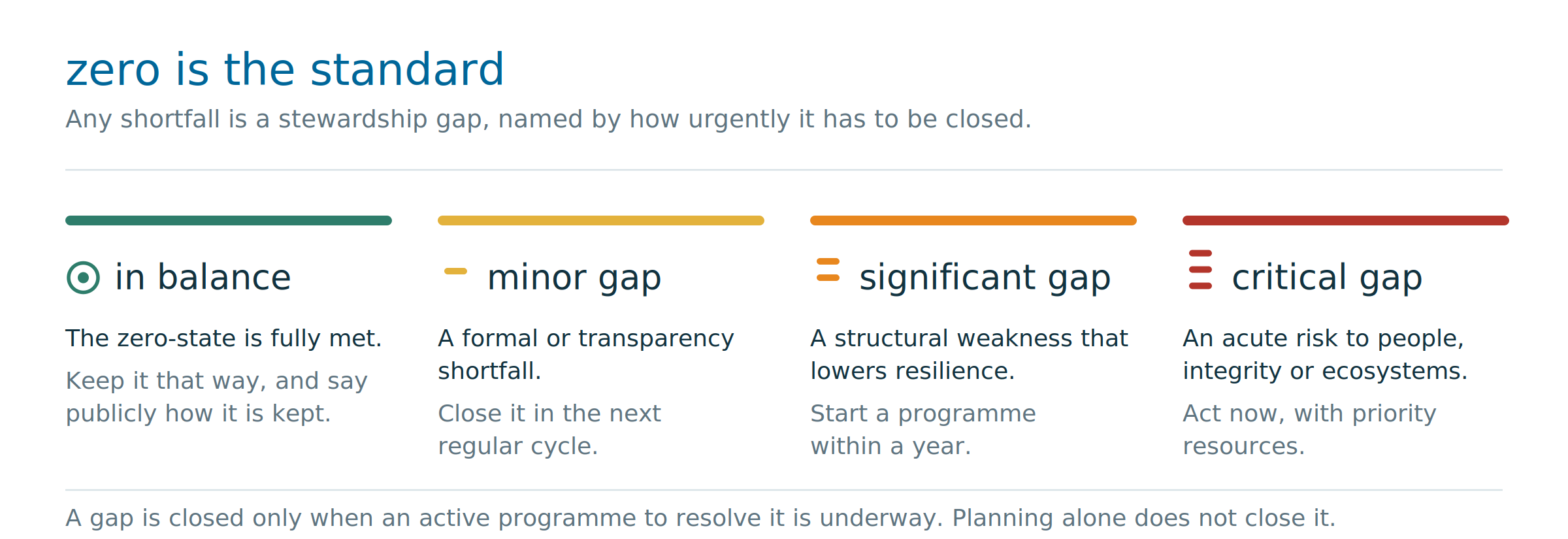
The rule at the foot of that scale is the one that matters most in practice. A gap is closed only when an active programme to resolve it is under way. A concept, a resolution of intent or a line in a plan does not close it. This is the difference between a system that reports progress and a system that produces it.
declared and measured
A gap has two parts, and both shall be shown.
The declared part
Where an authority deliberately sets its level of ambition below the zero state – a protection target met in 80 of 100 cases, for instance – it has declared 20 of 100 cases as not covered. That is a legitimate decision, taken by the elected body, and it is the first part of the gap.
The measured part
Beyond that lies whatever actual capacity fails to deliver even against the reduced level of ambition. That is the second part.
A report that names only one of the two states the gap incompletely. Most reports name only the first, which is why a shortfall so often looks smaller on paper than it is on the ground.
every number carries its origin
Each figure used shall be marked as measured, modelled or assumed, and carry its source and date. Where a figure is assumed, the assumption shall be stated in words a non-specialist can check.
From this follows the rule that does most of the work: no measure, procurement or investment recommendation may be derived from a data basis that the analysis itself describes as incomplete. Where a plan states that an evaluation is still required, the only admissible conclusion is to carry out that evaluation.
These are documentation duties, not investment duties. They generate no capital expenditure and cannot be declined on budgetary grounds.
assessed developments
A proposal shall be tested against the developments that are already foreseeable over its lifetime – demographic change, climate, energy, trade, technology – and the assumptions used shall be published with it.
This is not forecasting. It is the refusal to plan a thirty-year asset on the assumption that the next thirty years resemble the last ten.
proof of financing
Financing shall be proven over the whole lifetime of what is decided, including the recurring costs that follow from it – operation, maintenance, staff, replacement.
Where a measure is funded, it shall be stated openly what is postponed or not pursued in order to fund it. A budget decision always has this second half; writing it down is what makes the trade-off a decision rather than a consequence.
indicators
Which indicators an authority uses is for that authority to decide, and they are published with the plan they belong to. Prescribing a universal list would contradict the rule that no standard shall be adopted without local derivation.
What every indicator shall carry is fixed:
- the zero state it is measured against
- a measured current value, with its method published
- the way the gap is to be closed, with measure, estimated cost and the office responsible
- a named person responsible, with a deputy
All values shall be expressed so that they remain comparable between authorities of any size – as ratios, coverage rates, per-capita values or times. Absolute values are admissible only where a physical minimum applies, and then their derivation shall be stated.
the annual report
Once a year the authority publishes, for every declared aim, the zero state, the measured deviation, the way that would close it and the decision taken on it. Obstacles to measures that are professionally indicated shall be named explicitly.
A gap that has been formally accepted remains a gap. It is restated in every subsequent report until it is closed or decided again. Whoever carries a gap should see it every year.