In early October 2026 Uber’s chief executive toured Zagreb, Berlin and Munich and announced, in a Handelsblatt interview, a Munich pilot with automated vehicles and safety drivers, with driverless operation expected in Zagreb the following year. One statement from that interview describe the situation better than any forecast. Automated vehicles currently cost considerably more per kilometer than human-driven ones, and he expects seven to ten years before the business earns real money once infrastructure is counted; for the next five years the aim is safety and growth, not profit. A service that can run at a loss for a decade can undercut public transport on price for a decade. That is a capital race, and no city wins a capital race. Ride-hailing already ran this sequence once: expansion, then market share, then prices that rise when the alternatives have thinned out.
What is being competed for has changed, though, and that is the part a city should attend to. The first round competed for passengers. This one competes for street space – kerb length, stopping places, and the right to circulate while waiting for the next fare. Those are public assets, and at present they are free. Cheaper rides also mean more rides. That is good for the operator and it adds traffic for everyone else, which is where the interests of a platform and a city separate for good.
public on demand minibuses
Suburban trains, underground, trams and buses are the backbone of public transport in any city. But a regular line cannot run everywhere and at every hour. On the outskirts, in villages and late at night, many people still have no choice but the car.
On-demand minibuses close this gap. You book a ride by app or by phone, the bus picks you up close to where you are, and you share the trip with others going the same way.
part of the network
On-demand minibuses extend public transport into the places and hours where a regular line does not pay. They add to the network and leave the main lines strong. They use the same ticket. And what every public transport service owes its passengers applies here too: it is accessible, it is safe, and it is affordable.
what a good service has to offer
A service counts only when it actually runs. A service that is planned, funded or announced does not.
- a stop within 400 m in dense areas and 800 m on the outskirts
- service at the hours people need it, including nights and early shifts
- a maximum waiting time, and a journey time that can compete with the car
- step-free boarding with a ramp, space for wheelchairs and prams, announcements in sound and text, help on request
- room for at least one bicycle, so the bus extends cycling, and a way home when a bike breaks down
- a ride that feels safe, by day and by night
Where this standard is met, people who depend on their car today can make the switch.
a fair fare
The minibus is part of the local fare and is never surge-priced. A flat annual ticket in the region of 365 € is a good way to go. Vienna introduced one in 2012, and the number of annual tickets sold doubled within five years.
Once the ticket is bought, every further trip costs nothing extra. That is exactly the position the private car holds in the mind of its owner today.
Why not make it free? Because every euro lost at the fare box is missing for the service itself. A 2026 study from Sydney comes to the same result.
how a city gets it
A city does not need to wait for a market. It can procure the service as a public service under EU rules, with the city or the transport authority as the client.
In the contract the city sets the area, the hours, the fare, accessibility, the vehicle and what happens with the data. Contracting for a service is a power every city already has.
And it can start today, with drivers. Automation can follow step by step, where drivers are hard to find.
requirements for every minibus
These requirements apply to every on-demand minibus, with or without a driver. They are a minimum. Each city can add more, see the options at the end of this part.
ride
- urban speed class: operation at up to 50 km/h within the urban area, which keeps kinetic energy low; classes of 70 km/h, optionally 80 km/h, only on defined regional corridors
- acceleration limit: maximum longitudinal acceleration of 1,2 m/s², with overrides only for safety-critical situations where they prove meaningful; this prevents motion sickness and saves energy
- jerk limitation: the rate of change of acceleration is strictly limited, so that starting and braking are smooth and safe for standing passengers
- regenerative braking first: on electric buses, energy recovery is the primary way of slowing down; friction brakes are reserved for emergencies and the final stop, which saves energy and reduces brake dust
access and comfort
- low floor and a ramp for boarding
- space with a securing system for at least one wheelchair and one pram or pushchair, in every vehicle or as a fleet share with a guaranteed maximum waiting time
- announcements in sound and text, high-contrast displays, plain language in the local language and English
- a rack for at least one bicycle, for example on the outside of the vehicle
- interior design: bright lighting, clear sightlines, non-slip flooring, ergonomic handrails
- robust build: vandal-resistant materials
service
- public service contract: the city or the transport authority sets area, hours, fare, accessibility, vehicle and data use in the contract
- service standard met in operation: coverage, hours, waiting time, accessibility, personal security and fare are met in daily operation and published regularly
- part of the network: the contract defines where and when the service may be booked, so that it extends the regular lines into places and hours they cannot serve economically
- integrated fare: part of the local fare, not surge-priced
- duty to serve: every booking within the declared service area and hours is served at the regular fare
- published acceptance rates, so that refused bookings become visible
- visible code of conduct: clear house rules in the vehicle and in the app, consistently enforced
transparency and data
- incident reporting: standardised and mandatory reporting of technical and social safety incidents to the public authority
- public indicators: incidents per 100 000 journeys, complaint rates and control centre response times, published regularly
- passenger counts only: occupancy is counted from bookings or a certified sensor, without images, biometrics or identity
- data stays in Europe: all operational and personal data is processed and stored within the EU
options a city can add
- lit and stepless stops with an emergency call point
- indicators published per route and time band
- further indicators such as night-time abandonment rates and user satisfaction
additional requirements for automated minibuses
A bus without a driver has no one on board who can step in. Whether people, above all women and older people, feel safe decides whether the service is used at night. And night is when it matters most.
Automated minibuses meet all requirements for every minibus, and in addition:
vehicle and operation
- approval: approved for driverless operation under applicable law
- automatic ramp at every door used for boarding
- defined handovers: standard procedures for road works, emergency incidents and police closures
- robust build: secured sensor housings and alarms for tampering
- remote driving is not part of normal operation
safety
- emergency call points within reach of every seat, barrier-free, with a voice connection to the control centre, more than an alarm that merely sounds
- safe-stop logic: in case of conflict, the control centre can direct the bus to a suitable place where help can reach it quickly
- accountability without identification: public transport can be used without an ID, and the service keeps that principle; a person can be excluded after harassment, violence or vandalism through a pseudonymous account, without the operator learning who they are on every journey
- sanctions: temporary or permanent bans for harassment, violence or vandalism
- 24/7 control centre with a real intervention chain: immediate contact, defined escalation stages, a fixed reporting route to police or municipal enforcement, and a published response time
- de-escalation training for control centre staff, in conflict resolution and crisis management
- phased introduction: daytime first, then evening, then night, each stage entered only after proven performance and public acceptance
software and data
- software transparency: a full list of all software components, for supply chain security and tracking of vulnerabilities
- all servers must be within the EU
options a city can add
- rapid response teams able to intervene in person, whether operator staff, municipal enforcement or police, trained in de-escalation and with clear decision-making authority
- event-based detection: automatic triggers for screams, sounds of violence, breaking glass or heavy impact, without continuous recording; event data captured only on trigger, kept briefly and used only for a stated purpose
- companion mode: for older passengers and children, with automatic status updates to a nominated contact, on an opt-in basis
- booking options for those who need protection: travelling alone, travelling only with verified passengers, and a night mode without pooling; matching rules explicit, opt-in and in line with equal treatment law; stricter verification applies only to those who choose it
modular minibuses vs robotaxis
Instead of allowing US Oligarchs to flood our streets with their robotaxis, we need a extended public service model fully aligned with the EU’s framework for Public Service Obligations (PSO) and in full compliance with the GDPR and the European Data Strategy, keeping our citizens’ data secure and sovereign. Municipalities must remain the directors of mobility. They should also lead the way in Mobility as a Service (MaaS) and autonomous on-demand transport.
We need to start NOW with human driven minibus systems (as already proposed in 1970 in “A Pattern Language“), also as a preparation to near future automated minibus services.
Advantages of a modular vehicle system
Most robotaxis are just modified conventional cars.

A few robotaxi have their specific fixed body design.

In contrast, modular platform solutions separate the drive module from the functional modules.
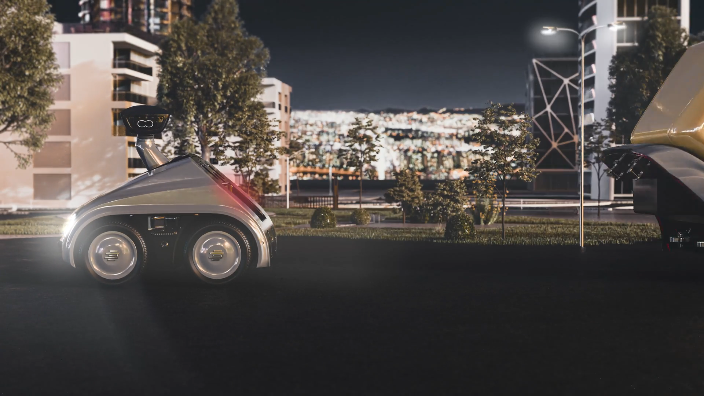
Edag CityBot (actually the modules can’t drive by its self, so the platform has to drive and adopt)
| feature | classic Robotaxi | modular platform system |
| primary purpose | passenger transport | universal mobility platform |
| vehicle flexibility | zero (fixed body) | extremely high (interchangeable modules) |
| operating time | demand-dependent (peak hours) | 24/7 (via task switching) |
| target group | ride-hailing users | cities, logistics companies, commuters |
| infrastructure | replaces taxis/private cars | improves public transport + replaces cars + service vehicles |
24/7 utilization and economic efficiency
- Robotaxi
One of the biggest disadvantages of robotaxis is their dependence on peak hours (morning/evening). And robotaxis often sit idle at the curb or in a depot during low-demand periods or worse driving around places where potential customers might need one. - modular platform system
- public transport
- municipal services
During off-peak hours or at night, it can be equipped with specialized modules for street cleaning, waste management, watering green spaces, or even serving as a mobile parcel locker. - logistics
In case passenger transport is not needed, it can be converted into a cargo carrier for “last-mile” deliveries. - Can operate around the clock. When there is no demand for passenger transport, the module simply switches for other uses. This leads to significantly higher capacity utilization and faster amortization of the investment.
urban space optimization
The multi-purpose nature of these platforms drastically reduces the total number of vehicles required in a city. Instead of maintaining separate fleets for public transport, postal delivery, and so on, a single, unified fleet handles all tasks.
technical ecosystem and maintenance
- Scalability
Since the intelligence and drive systems are located within the “skateboard,” technical updates (e.g., new sensors or better batteries) only require upgrading the drive units, not the entire vehicle body. - Maintenance
A defective module (e.g., damaged seats in a passenger module) does not paralyze the entire system. The skateboard simply hitches to a different module and continues working while the module is repaired.
Comparative analysis of modular platform systems
First of all a study needs to examines the existing platform modular systems and identify the possibly best system.


technical framework draft
European platform-module interoperability
Version 11.01.2026
Introduction & Scope
This standard shall define the requirements for an Open Source Industrial Standard between an autonomous platform (chassis) and various Modules (functional units). The primary objective is to guarantee full interoperability, prevent vendor lock-in, and foster a competitive European ecosystem for modular urban mobility.
Core Philosophy: Precision where necessary, freedom where possible. This standard focuses exclusively on data & traffic safety and technical compatibility. These parameters are defined with high precision to ensure functional safety (ISO 26262) and seamless interoperability.
Beyond these safety-critical and interface-related specifications, this standard imposes no further requirements. This “minimalist” approach is intentional: it provides manufacturers and developers with maximum creative and technical freedom to innovate platform and module designs, while ensuring they remain part of a safe, unified ecosystem.
mechanical interface (the physical “Snap”)
The mechanical connection must ensure safe operation under all urban conditions while allowing for fully automated module swaps within < 60 seconds.
- Load Bearing PointsDefinition of standardized hard-points for structural connection to handle static and dynamic loads (ISO 26262 relevant).
- Alignment & TolerancesSpecification of conical or tapered guiding systems for sub-millimeter precision during automated docking.
- Locking MechanismRequirements for redundant, fail-safe locking systems (mechanical + electronic verification)
- Dimensions & Weight Classes
Definition of standardized “Envelopes” (S, M, L) for modules to ensure compatibility with city infrastructure and platform load capacities.
Electrical & Power Interface
To handle the energy demands of various modules (from simple cargo to climate-controlled passenger pods), a bi-directional power flow is required.
- High-Voltage (HV) ConnectorStandardized automated HV-plug system (IP69K rated) for 400V/800V architectures.
- Low-Voltage (LV) Supply12V/24V/48V supply for modular sensors, lighting, and internal electronics.
- Energy Sharing LogicSkateboard provides traction power while modules may provide supplementary energy (Range Extender Logic) or draw power for auxiliary systems (HVAC, refrigeration).
- Thermal ManagementInterface for shared cooling/heating loops between skateboard and module (optional/modular)
Data & Control Interface (the “digital twin”)
The data interface must guarantee that the module can communicate its intent and requirements to the skateboard’s “brain” without compromising functional safety.
- Communication ProtocolHigh-speed Ethernet or automotive CAN-FD bus standards
- Drive-by-Wire APIStandardized command set for steering, braking, and acceleration requests (limited to safety-critical thresholds)
- Module IdentificationAutomated “Handshake” to identify module type, weight, center of gravity, and safety certificates (Cybersecurity/ISO 21434).
- User Interface (HMI) PassthroughStandard for connecting module-internal screens/intercoms to the skateboard’s 5G/V2X communication unit.
cybersecurity & sovereignty (the “open source” pillar)
To ensure long-term strategic autonomy for European municipalities, the interface must be built on principles of transparency and resilience.
- Open Source Reference ImplementationTo prevent proprietary lock-ins, the core communication protocols and APIs must be published as an open-source reference implementation. This allows any European manufacturer to develop compatible modules without licensing hurdles.
- Software Bill of Materials (SBOM)Mandatory transparency for all software components within the skateboard and module to ensure supply chain security and vulnerability tracking.
- Data Sovereignty & Local Processing
Standardized requirement that all operational and personal data (GDPR-compliant) is processed locally or within European jurisdiction. No “phone-home” tunnels to non-EU servers are permitted. - Cryptographic Pairing (Zero Trust)
Implementation of a standardized, open-source handshake protocol using Hardware Security Modules (HSM) to authenticate the Module to the platform, preventing “Module-Hijacking” or unauthorized hardware clones. - Resilience & FallbackOpen standards for “Minimum Risk Manoeuvres” if the data connection between Skateboard and Module is compromised (Fail-Safe logic).
Operational Performance & Dynamics
To ensure energy efficiency, passenger comfort, and urban safety, the standard defines specific performance envelopes for the platform-module entity.
- Standard speed class (urban-50)
The default operational class is limited to 50 km/h. This ensures optimized sensor range requirements and minimizes kinetic energy in urban environments. Optional higher classes (e.g., regional-70) may be defined for specific corridors. - Acceleration limits (comfort & efficiency)
Maximum longitudinal acceleration is capped at 1.5 m/s² (subject to safety-critical overrides). This reduces battery drain and prevents motion sickness. - Jerk limitation (smoothness)
To ensure a premium “Public Service” feel, the rate of change of acceleration (jerk) is strictly limited, ensuring smooth transitions during starting and braking. - Deceleration profilesStandard braking for energy recuperation is prioritized. Mechanical friction braking is reserved for emergency scenarios and final standstill.
Safety & Regulatory Framework
- Functional Safety (FuSa)
Joint safety case requirements between platform (ASIL-D) and module. - Social Safety by Design
- Incident Data Recorder (IDR)
Standardized logging of interaction data between platform and module for accident reconstruction.
further aspects
The platform system shall be developed for different classes (to be discussed)
- mass class 1: max 5 t
- mass class 2: max 10 t
- mass class 3: max 20 t
- speed class 1: max 30 km/h
- speed class 2: max 50 km/h
- speed class 3: max 70 km/h
At first the focus shall be on a Version mass class 1 and speed class 2
size
2 m width x ? m
drive system
motor performance, peak performance
2-wheel vs 4 wheel drive?
2-wheel steering vs 4 wheel steering?
wheel motors vs central motor(s)?
wheel size
depending possibly on the space needed for wheel motors
as compact as possible
as comfortable and efficient as possible
Batteries
integration into the skateboard
interchangeability of batteries
storage capacity
max size needed
battery technology
Battery management / charging
…